For anyone whose inner critic is loud: six guided prompts, written right here, kept nowhere.
By the Dear You team · Updated November 2026
Dear You,0:00
Try it tonight · Free on iPhone
How do you write a self-compassion letter?
Pick one thing you're hard on yourself about. Write to yourself the way a friend who loves you unconditionally would: remind yourself everyone has flaws, notice what shaped this, and gently ask what might help. Then put the letter away and reread it on a hard day. It takes 5 to 15 minutes.
Those steps come from the Self-Compassionate Letter practice on Greater Good in Action, UC Berkeley's library of research-based practices. It suggests 5 to 15 minutes a day for the first week, then about once a week or once a month. The guided letter at the top of this page walks through the same six prompts.
Pick one thing
Something that makes you feel mildly ashamed, insecure or not good enough. Start small: "I snapped at my kid", not "I'm a bad parent."
Picture a kind friend
Imagine someone who loves and accepts you unconditionally. Write in their voice, or ask what you'd say to a friend in your place.
Remember you're not alone
Everyone has things they dislike about themselves. Say so in the letter.
Look at the causes
Life events, the family you grew up in, even genetics may have played a part. This isn't excusing; it's seeing the whole picture.
Ask a gentle question
Is there a way to cope or improve? Ask it the way a friend would, without judging the answer.
Set it aside, then reread
Put it away. Read it again later, especially when you're feeling bad about this part of yourself.
Write the letter your best friend would write, then let yourself receive it.
Inside Dear You
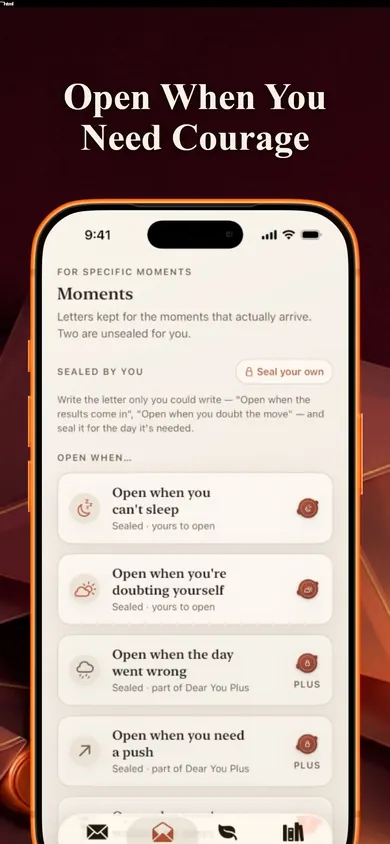
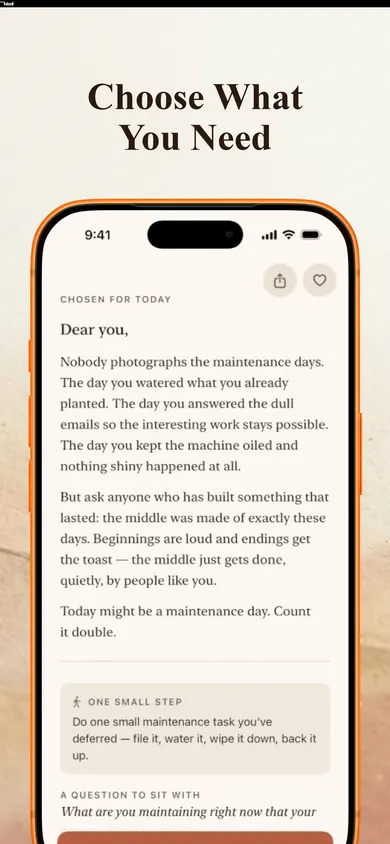
Open When: seal your own letter for "when you're doubting yourself"A letter for today, ending with one small step
Step 6 is the one most people skip, because a letter in a notes app gets buried. Dear You's Open When shelf lets you seal envelopes of your own, in your own words, for real moments like "doubting yourself" or "starting over", and open the right one when the moment arrives. Two Open When letters are free, along with your first daily letter and write-back notes.
The evidence, briefly
Study
What people did
What changed
Shapira & Mongrain, 2010
Wrote a self-compassionate letter daily for one week
Fewer depression symptoms at three months; happiness gains lasted six months
Breines & Chen, 2012
Wrote one compassionate paragraph about a weakness
More motivation to improve than a self-esteem or distraction group
Neff & Germer, 2013
Eight-week Mindful Self-Compassion program, letter included
More self-compassion and life satisfaction; less depression, anxiety, stress
All three as summarized by Greater Good in Action, UC Berkeley. The Neff & Germer program had many parts, so the letter's own share of the effect isn't known.
Questions about self-compassion letters
Is self-compassion just letting myself off the hook?
The research suggests the opposite. In the 2012 Breines and Chen study, people who wrote kindly about a weakness reported more motivation to improve, not less.
What if writing it makes me feel worse?
That can happen. Greater Good notes one study of Hong Kong students where negative emotion rose. Stop, keep it short next time, or talk to someone you trust.
Should I send it to anyone?
No. This letter is for you. Its value comes from rereading it on a hard day.
How often should I write one?
Greater Good suggests 5 to 15 minutes daily for the first week, then weekly or monthly, whichever fits.
Honest limits, and who should pick something else
This practice is designed for everyday self-criticism, not for depression or crisis. Greater Good notes it "may not benefit everyone equally", and in one study negative emotion went up. This is general information, not medical advice. Talk to your clinician if you're struggling. In the US, call or text 988 for the 988 Suicide & Crisis Lifeline.
Dear You is a reflection and writing app, not a medical or mental-health service. Pick something else if you want a therapist-led program, a mood tracker with charts, or an Android app. One design decision we kept: Dear You has no streaks. A quiet week costs you nothing, because a self-compassion habit shouldn't punish you for missing a day.
One letter, sealed for later
An example of how it can go. Say you're hard on yourself about a missed deadline at work. Fifteen minutes, six prompts, and the last lines might read:
"You are not the only person who has dropped a ball while carrying too many. You were tired, not careless. Next time, ask for the extra day before you need it. I'm proud of how hard you try."
You seal it in Dear You as "Open when you're doubting yourself." Three weeks later, on a different bad day, you open it. That's step 6, done for you by a sealed envelope.
Keep the letter for the hard day.
Write it, seal it in Open When, and let your kinder self show up when you need it.