For anyone choosing a small daily habit. Drag or tap six cards: you, or not you.
Card 1 of 6Drag left or right
Your fit
Download free on the App Store · Free on iPhone
From the Dear You studio · Updated November 2026 · 6 minute read
Are affirmations or journaling better?
Neither wins for everyone. Short affirmations are quick and suit people who already feel fairly good about themselves; one study found they made people with low self-esteem feel worse. Journaling takes longer but has broader evidence behind it. If you want the speed of one and the depth of the other, a short letter to yourself sits in between.
AffirmationsJournalingLetters
Both are small, private habits, and both are easy to do badly. The useful question isn't which is "best" in general; it's which one you'll actually keep doing, and which one helps on the days that are harder. Here's what the research says about each, without the hype.
What research says about affirmations
The best-known warning comes from a 2009 paper in Psychological Science by Joanne Wood, Elaine Perunovic and John Lee, "Positive self-statements: Power for some, peril for others". People with low self-esteem who repeated "I'm a lovable person" felt worse afterwards than those who didn't. People with high self-esteem felt a little better, and the benefit was limited.
A different kind of affirmation looks more promising. In psychology, "self-affirmation" usually means reflecting on values that matter to you, not repeating a slogan. A 2016 brain-imaging study led by Christopher Cascio in Social Cognitive and Affective Neuroscience found that reflecting on future-oriented core values engaged brain regions tied to self-related thinking and reward more than thinking about everyday activities.
A sentence you don't believe can sting. A value you do believe tends to hold.
What research says about journaling
Expressive writing (writing about your thoughts and feelings for short sessions) is one of the most studied self-help practices. A 2006 meta-analysis by Joanne Frattaroli in Psychological Bulletin pooled 146 randomized studies and found a positive, significant effect, with an average effect size of r = .075. That's real, and it's small. Journaling is a gentle habit, not a cure for anything.
The cost is time and a blank page. Plenty of people buy a nice notebook, write three entries, and stop because they don't know what to say. That's the problem prompts, and letters, are good at solving.
Affirmations vs journaling vs letters
Affirmations30 seconds. Works if you already believe it.
Letters to yourself5 minutes. Kind words, plus a question to answer.
Journaling10 to 20 minutes. Deepest, hardest to start.
Affirmations
Journaling
Time
Under a minute
10 to 20 minutes
Blank page?
No, the words are given
Yes, unless you use prompts
Best evidence
Values reflection, not slogans
146-study meta-analysis, small effect
Can backfire
If it feels untrue
Rarely; can feel heavy
Best for
A quick reset you believe
Working something through
Our own app is the middle card, so take this with that in mind: Dear You is ours. We built it because we kept wanting the warmth of an affirmation with a reason to write something back.
How Dear You does it
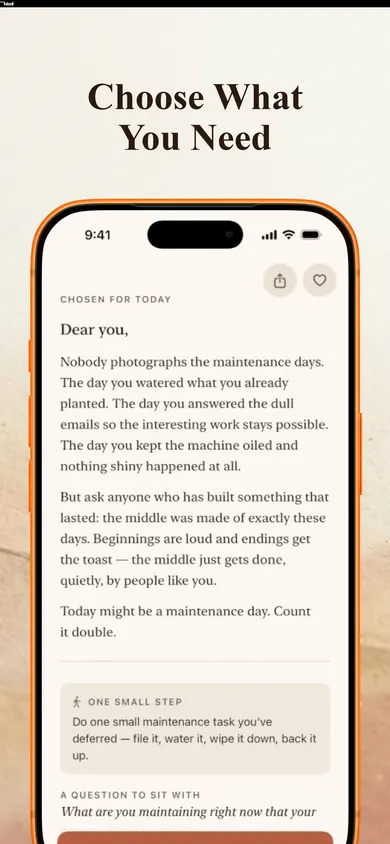
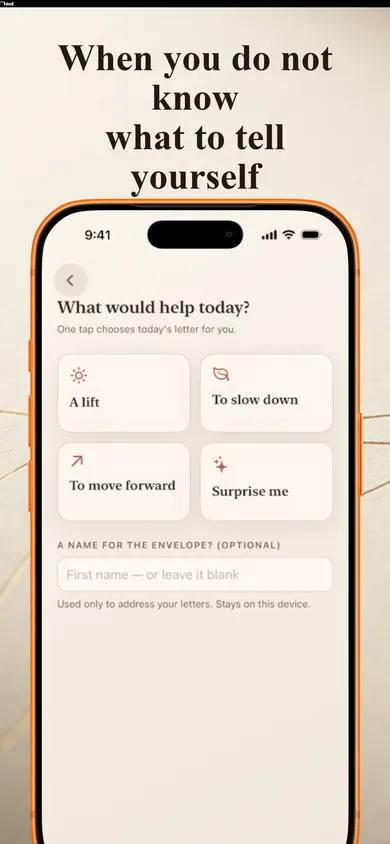
A letter for today, ending with one small step and a question.Choose what you need; one tap picks today's letter.
You choose what you'd like (a little encouragement, a moment of calm, a fresh start, courage, gratitude or a surprise) and Dear You opens an original letter chosen for it. Every letter ends with one small, doable step and a question worth writing back to, so it's never a slogan you have to swallow. You can write back privately, seal letters for your future self, and keep everything on your iPhone with Face ID. There's no quote feed and no streak to lose. The first daily letter is free; Dear You Plus is an optional subscription for a fresh letter every day and more.
A morning, three ways
It's a Tuesday with a hard meeting at ten. One version of you says "I am confident" into the mirror and doesn't quite believe it. Another opens a journal, writes the date, and stares at the line until the coffee goes cold.
A third opens a short letter about courage that ends with a question: "What would you tell a friend walking into that room?" Two sentences back. Done in five minutes. An illustration, not a study, but it's the morning we designed for.
Honest limits
The card sort is a nudge, not a test. Six cards can't measure anything about you. It's there to help you notice what you'd actually stick with.
The research is small and specific. The affirmation backfire came from lab tasks with students; the journaling effect is real but modest.
Who should pick something else: if you love long, free-form writing, a plain notebook may suit you better than any app. If you want guided programs for anxiety or low mood, look for evidence-based support from a professional.
This is general information, not medical advice. Talk to your clinician. Dear You is a reflection and writing app, not a medical or mental-health service.
Affirmations and journaling questions
Can positive affirmations make you feel worse?
For some people, yes. In a 2009 study, people with low self-esteem felt worse after repeating "I'm a lovable person." Statements that feel true, or reflecting on values you hold, tend to work better than slogans you don't believe.
How long should I journal each day?
Many expressive writing studies used short sessions of around 15 to 20 minutes, but there's no magic number. Five honest minutes you'll repeat beats an hour you'll skip.
Can I do both affirmations and journaling?
Yes. A simple pairing is one sentence you believe, then a few lines on why it's true today. That's close to what a letter-and-reply does.
What should I write if I don't know where to start?
Answer one question: what's one thing you want to remember about today? Prompts and letters that end with a question make the first line much easier.
Kind words, and a reason to write back.
An original letter for today, one small step, and a question worth answering.