
Does writing to your future self work?
For people who write letters to future you
Four beliefs about future-self letters, checked against three studies. Tap a seal length to date yours.
By the Dear You team · Updated November 2026
Does writing to your future self work?
Partly, and it depends on how you do it. In published studies, letters helped most when people also wrote a reply from their future self, and when they wrote to a self far away rather than a few months out. For people feeling low, writing to a past self lifted mood more than writing ahead.
We build Dear You, an app for sealed letters to your future self, so we had a reason to check the claims people repeat about this habit. Most pages on page one say it "builds self-awareness" and stop there. The research is narrower and more useful than that. Here are four beliefs we kept seeing, and what the studies we could trace actually found.
Any letter to your future self builds the connection.
FactThe reply seems to matter. Yuta Chishima and Anne Wilson's study in Self and Identity (published online 2020) had Japanese high-school students write to themselves three years ahead. Students who also wrote back as that future self felt more connected to it, and a month later reported more career planning. Students who wrote only the one-way letter showed no such change. Source: Society for Personality and Social Psychology summary
Write to next-month you. A close self feels more real.
FactDistance helped in the one controlled test we found. In Rutchick and colleagues' 2018 paper in the Journal of Experimental Psychology: Applied, 498 undergraduates wrote either to themselves 20 years out or 3 months out. The 20-year group was 1.43 times as likely to exercise over the following diary days, about 12.9 versus 9.3 minutes a day. Source: Rutchick et al., 2018 (PDF)
Writing to your future self always feels good.
FactNot always. A 2024 study in Frontiers in Psychology by Sugimori, Yamaguchi and Kusumi compared kind letters to a past self five years back with letters to a future self five years ahead. Writing to the past self reduced negative feelings more, and letters about shared experiences with other people helped mood more than letters about things done alone. Source: Sugimori et al., 2024
The payoff comes years later, when you open it.
FactIn all three studies, the measured effects showed up within minutes, days or a month of writing. Nobody waited years to open anything. The writing does the work; the opening day is a bonus, a nice one, but not the mechanism these studies tested.
Write to a far-off you, then answer as them. That two-way exchange is the part the evidence keeps pointing at.
What these studies can't tell you
Honest limits first, because they change how much weight to put on any of this. All three studies used students: high schoolers in Japan, university undergraduates in the US and Japan. Follow-ups ran from a single session to one month. The exercise result was self-reported in nightly diaries, not measured with a tracker. And none of these studies tested an app, ours included.
| Study | Who | Distance | Follow-up |
|---|---|---|---|
| Chishima & Wilson, 2020 | Japanese high-school students | 3 years | 1 month |
| Rutchick et al., 2018 | 498 US undergraduates | 20 years vs 3 months | Nightly diaries |
| Sugimori et al., 2024 | Japanese undergraduates | 5 years back vs 5 ahead | Same session |
So treat the findings as good hints about how to write, not proof that a letter will change your year. The summary in one line: small studies, consistent direction, worth trying, not worth overselling.
A worked example: one letter, start to reply
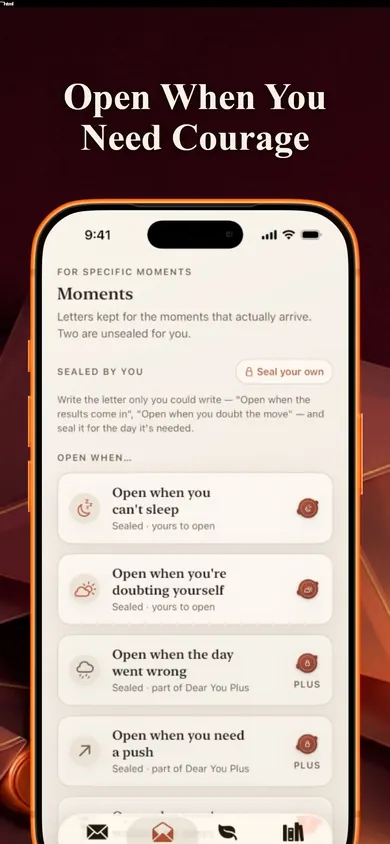
Here is how we'd use the research with a real goal, say, getting strong enough to hike a long trail in three years. Pick 3 years in the calculator above and you get the opening date. Then follow these stops in the app.
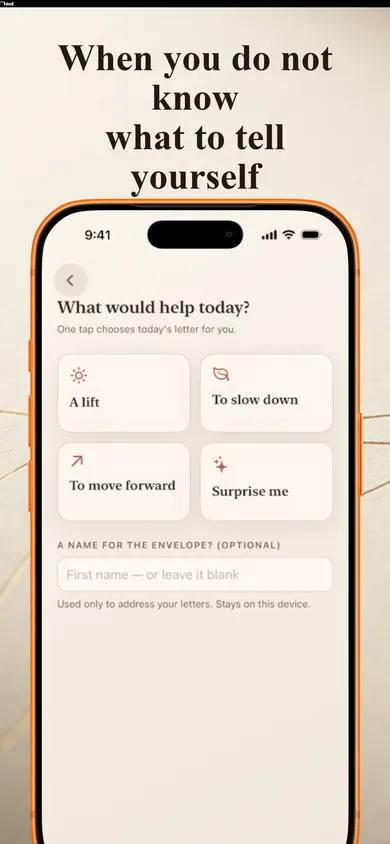
Start with today's letter
- Tap To move forward. Dear You opens an original letter chosen for that.
- Every letter ends with one small, doable step and a question worth writing back to. Answer it; that's your warm-up.
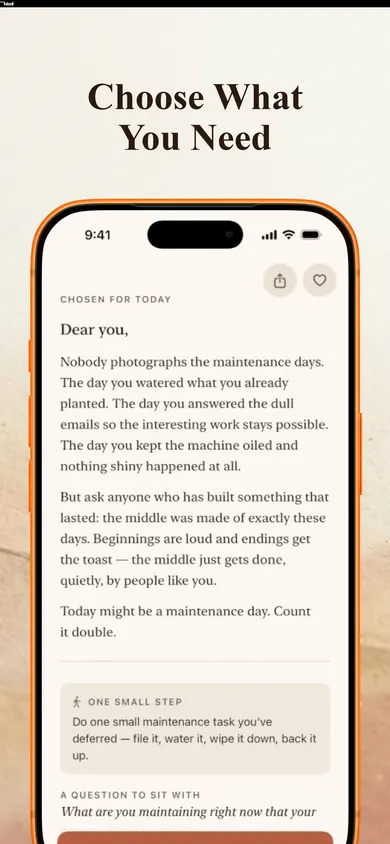
Write to three-years-on you
- Write the letter to your future self and seal it for three years. It stays locked until its day, even from you.
- Before you seal it, do the step most people skip: add a few lines written as three-years-on you, answering what you just asked. That is the reply the students wrote in the 2020 study.
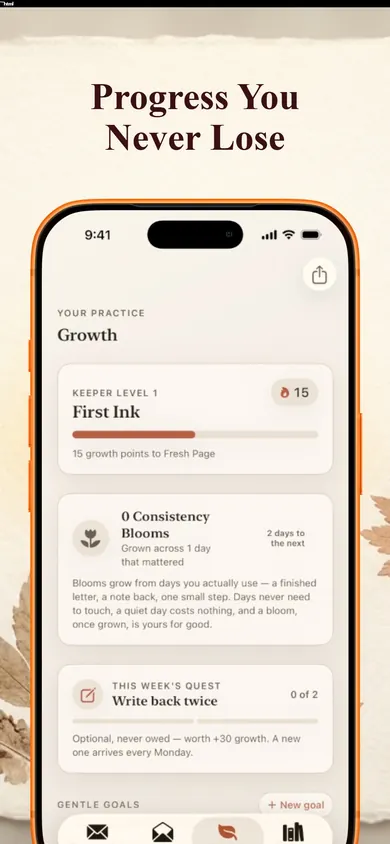
Keep going without streaks
- Consistency Blooms grow from days you actually use the app. A quiet week costs you nothing.
- When the letter arrives, write back and seal the reply for a later you. Letter threads keep the conversation going for years.
How sealed letters to your future self work in Dear You
- 1
Write
Write in your own words. Your letters stay on your iPhone, with no account, no ads and no analytics.
- 2
Seal
Choose a week, a month, a year, three years or five. The letter is locked until that day, even from you. That was a deliberate design decision: a letter you can peek at stops being a letter to someone else.
- 3
Open and reply
On its day it opens right in the app. Write back and seal the reply for a later you, so the exchange keeps going.
The free version includes one future letter waiting at a time, your first daily letter, two Open When letters, write-back notes, search, Face ID lock, PDF export and backup. Dear You Plus, an optional subscription, adds unlimited future letters. One limit worth knowing: the longest seal is five years, so the 20-year letter from the 2018 study is something you can write to, but it will open within five years. For a true 20-year letter, paper in a drawer still works.
Who should pick something else
- You want a letter delivered by email decades from now. Dear You keeps letters on your phone and seals for five years at most. An email-based service such as FutureMe sends letters to an inbox instead.
- You're going through something heavy right now. Dear You is a reflection and writing app, not a medical or mental-health service. If you're in the US and struggling, you can call or text 988.
- You want to share letters with a partner or friend. Dear You is private by design; there's no sharing feed. Printable PDFs are the closest thing.
- You're on Android. Dear You is iPhone only.
Write the letter. Then write back.
Pick a distance, seal it, and answer as the person who opens it. Dear You keeps both halves of the conversation in one private place.